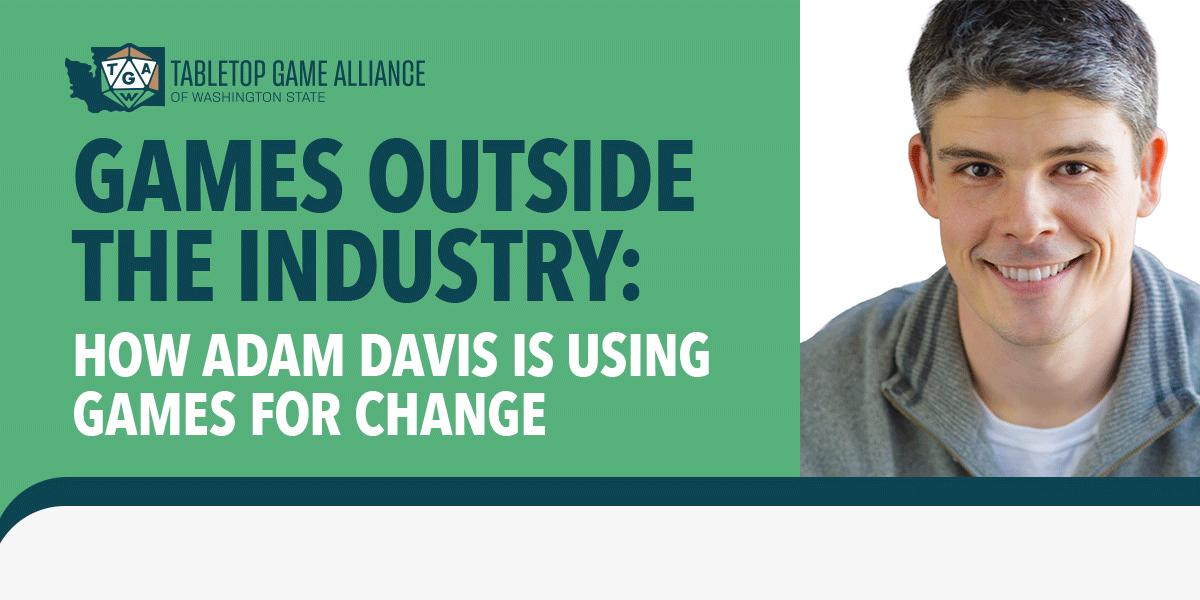

Tabletop gaming isn’t just about dungeon crawling and slaying dragons anymore. For Adam Davis, co‑founder of Game to Grow and now Games and Play Program Developer at an education and research organization, foundry10, games are tools for connection, healing, and growth. His work shows how a few dice and a good story can reshape social work, therapy, and education.
Davis discovered the potential of games almost by accident. While leading a Dungeons & Dragons group for teens in Seattle, he was also studying drama therapy. He realized the game’s storytelling mirrored therapeutic role play—helping players try on new identities, solve problems, and build empathy.
That insight led Davis and therapist Adam Johns to found Game to Grow in 2017, a nonprofit that used tabletop role‑playing games to help youth develop social and emotional skills. Their sessions welcomed anyone who wanted to participate, no diagnosis required. What started as two small groups became a movement.
Game to Grow grew quickly, training facilitators and serving hundreds of young players both in person and online. Their program Critical Core, launched in 2019, turned the group’s methods into a structured role‑playing kit now used by educators and therapists around the world.
The goal was never to “fix” people but to build communities where participants felt safe, seen, and supported. Davis described it as “sit‑down drama therapy with dice and dragons”—a way to practice the skills of being human within imaginative worlds.
Some of the program’s most moving work took place in hospitals. Game to Grow’s Hospital Gaming Program gave children a chance to become heroes instead of patients. “For 90 minutes, this kid is not a sick kid,” one staff member said. “He’s a hero.”
Moments like these revealed the deeper power of play: to remind people of their agency, creativity, and humanity—especially during hardship.
After nearly a decade, Game to Grow closed as an independent nonprofit, with its key programs continuing at the STAR Institute in 2025. Davis moved to foundry10, an education research organization with a philanthropic focus that brings games and play into schools at no cost.
At foundry10, he leads youth role‑playing programs and a year‑long Educators Guild, training teachers to use games for social learning—this time paying educators for participation. “Teachers shouldn’t have to pay out of pocket to bring play into their classrooms,” Davis said.
Davis’s journey mirrors a growing recognition that games belong everywhere people learn and grow. In therapy rooms, they foster empathy and communication. In classrooms, they engage students through story and collaboration. In hospitals and community centers, they build connection and hope.
The lesson isn’t just that games can heal—it’s that play itself is a form of care. Whether in a nonprofit, a school, or a research lab, when people play together, they imagine better worlds—and practice how to build them.
At the recent Future of Games Summit, Adam joined other panelists to discuss the importance of tabletop games being utilized in fields adjacent to the game industry.